Safety Matters – February 2026
 The H&S Dept
Highway to health
The government announced a new road safety strategy this January, the first in ten years. The ambitious aim is to reduce deaths and serious injuries by 65% by 2035. Currently there are four fatalities each day as a result of road traffic accidents, and it is thought every one in three of these involves a work-related driver.
So driving is actually among the most dangerous things a typical employee could do. Do you take it seriously enough in your business?
Whether the vehicle is company owned or grey fleet (owned and driven by the employee, but for work purposes, excluding commuting), you need to do a driving risk assessment. This may include the road and weather conditions, the state of the vehicle, and the driver themselves including any pressures they are under like fatigue or time pressure.
We’ve had several conversations recently about the importance of checking licences of employees who drive for the job. Are they appropriately qualified? Have they accumulated excessive points?
The DVLA and police regulate road safety. As well as the human cost when accidents happen, there can be serious legal consequences including Gross Negligence Manslaughter and Corporate Manslaughter.
If you would like a full review of driver safety within your organisation, please get in touch.
It’s a SAD, SAD situation
The latest Health and Safety Executive (HSE) annual statistics showed 964,000 workers suffering from work-related stress, depression or anxiety. Well into the depths of winter, January and February may well be the time when this is most noticed. Seasonal Affective Disorder (SAD) is real.
Left unchecked, it can be a huge drain on your business, and of course you have a duty of care towards employees. Early intervention can help. Try to initiate a conversation if you notice someone struggling. If they are unwilling, perhaps there is someone else who could help like a GP or the helpline provided via an Employee Assistance Programme if you have one.
Reasonable adjustments at work are the next go-to action for you. Can you adjust their workflow, give them extra support, or alter their hours? If it is a relatively minor condition, this may be all that is required. If it develops into something further though, there is more you’ll need to do. We can help.
Is your PPE fit for purpose?
In an eye-catching press release, the HSE reported that they fined Derbyshire Police £60,000 after four serving police officers suffered burns when petrol bombs were thrown at them during a training exercise.
One of the failings identified related to the lifespan, care and inspection of flame-retardant PPE. Hopefully there is no scenario in which you will be hurling petrol bombs at your own staff (and we must show our appreciation for the brave work our police forces do!), but you may well require personal protective equipment (PPE) for other more routine work.
In the hierarchy of health and safety management, you should first try to eliminate risk or reduce it through actions like engineering controls and safe systems of work. If risk is still present after this, then PPE may be used to mitigate it further.
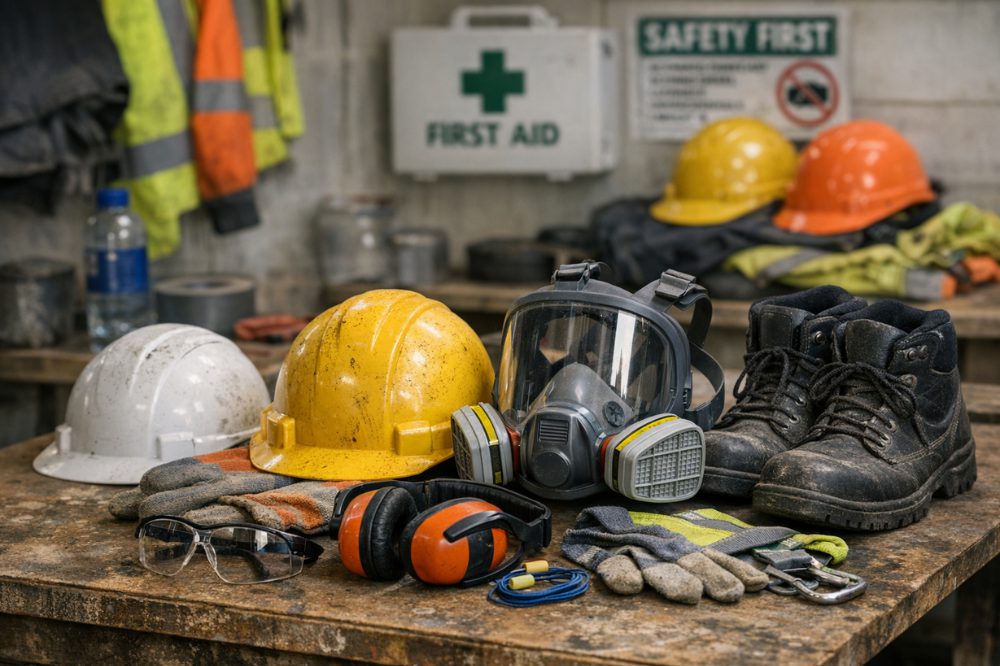
At this point, the correct selection of PPE is essential. Initially, consider who is being exposed to what and for how long, and in what quantity. This will help you decide the type and grade of PPE required. An occasional use of a noxious substance may not require the same PPE solution as persistent risk of exposure.
But then, also think about the fitting. A common mistake is to provide ill-fitting PPE which may not adequately protect or could create a new hazard such as baggy overalls getting caught in machinery. This could arise, for example, if you have employees of significantly different size who are left to rely on the same PPE. DIY modifications are not sufficient. Also check that multiple items of PPE will work together and not compromise each other.
Now comes training. Do your staff know when to use the equipment and how? There is no point supplying PPE only for it to be ignored, or not used properly. We offer a PPE training course which we cover in more detail below.
Storage and maintenance is also very important. Some PPE may be disposable, and of course should be disposed of appropriately. But many items may be reused and if so it should be cleaned, checked for damage and stored safely so that next time it is required it is in good condition.
Everything has a shelf life too, so be sure to understand the lifespan of every piece of PPE and replace it when it expires. That way, when someone throws the proverbial petrol bomb, your staff will stay safe.
If you would like an external review of your PPE usage, please get in touch with us.
Health & safety is for landlords too

It’s tempting to think that the HSE’s remit only covers workplaces. But if you are a landlord (residential as well as commercial) you also have to comply with a range of duties, fire safety being an obvious one, and gas safety another.
You need to ensure the property is in a good state of repair too, as an incident in Bristol exposes.
A landlord was ordered to pay nearly £25,000 in fines and costs after a guest of one of his tenants seriously injured themselves. They were attending an outside social event, and fell 11 feet landing on a concrete floor after leaning on the wooden handrail of a first-storey staircase which failed.
Aside from statutory obligations for checking things like gas boilers, it is important to develop, and stick to, a schedule for routine checks and maintenance. In the Bristol case, it was found that the staircase was poorly designed, and obviously rotten, deteriorated and weakened. This is exactly the kind of thing that a critical eye would pick up on such inspections.
Whether you are a residential or commercial landlord, we have a suite of services to help you: from fire risk assessments and planning, to auditing and training. If you know someone who might need professional help with this, please tell them of our service.
eLearning of the month: PPE training

We looked at the importance of PPE in an article earlier in this newsletter; how it is not just a tick-box exercise, but an important line of health and safety defence which requires careful thought, training and maintenance.
We offer a cost-effective, accessible 35-minute eLearning course which educates on these key points. It is suitable for those wearing PPE and managers supervising them as an introduction. During the course you will learn about the different hazards which PPE defends against, types of PPE, how to wear it and how to look after it.
The eLearning course is a great starting point for getting a good understanding of PPE in your business. eLearning can be done at yours or your employees’ own pace and provides an audit trail to show it has been completed. It is very scalable and cost effective if you need multiple people to take the course, or for people to take it at different times. For a fuller understanding of PPE in your business, you may also consider a face-to-face training course, which again we can help with.
You can find out more about our range of eLearning courses and make an enquiry on our website here or by picking up the phone. We are always happy to help.


